Alto manages the entire journey from incoming referral to completed care. Here is how it works.
Independently validated.
CE-marked Class I medical device.
In active pilot deployment.
Automate Your Workflow, End-to-End
PLATFORM

Ready to deploy
92% accuracy out of the box, refined to your site and thresholds, and inbuilt QA to catch the rest.
Secure by design
Auditable and configurable at every single step
Interoperable
Integrated directly into existing technology stacks. No new system for your referrers or patients, and no rip-and-replace for you.
The Problem Alto Solves
In most hospitals and specialist clinics, the path from referral to care is not a workflow. It is a series of manual steps and handoffs, each one a potential failure point. Referrals arrive across multiple channels and formats, and 1 in 3 arrive incomplete. Before a clinician ever sees a referral, it takes 40-70 minutes of administrative handling: opening, matching, checking, chasing, routing. Demand exists before it is operationally visible, and the blockers that stop a patient being procedure-ready surface too late to protect the appointment or slot.
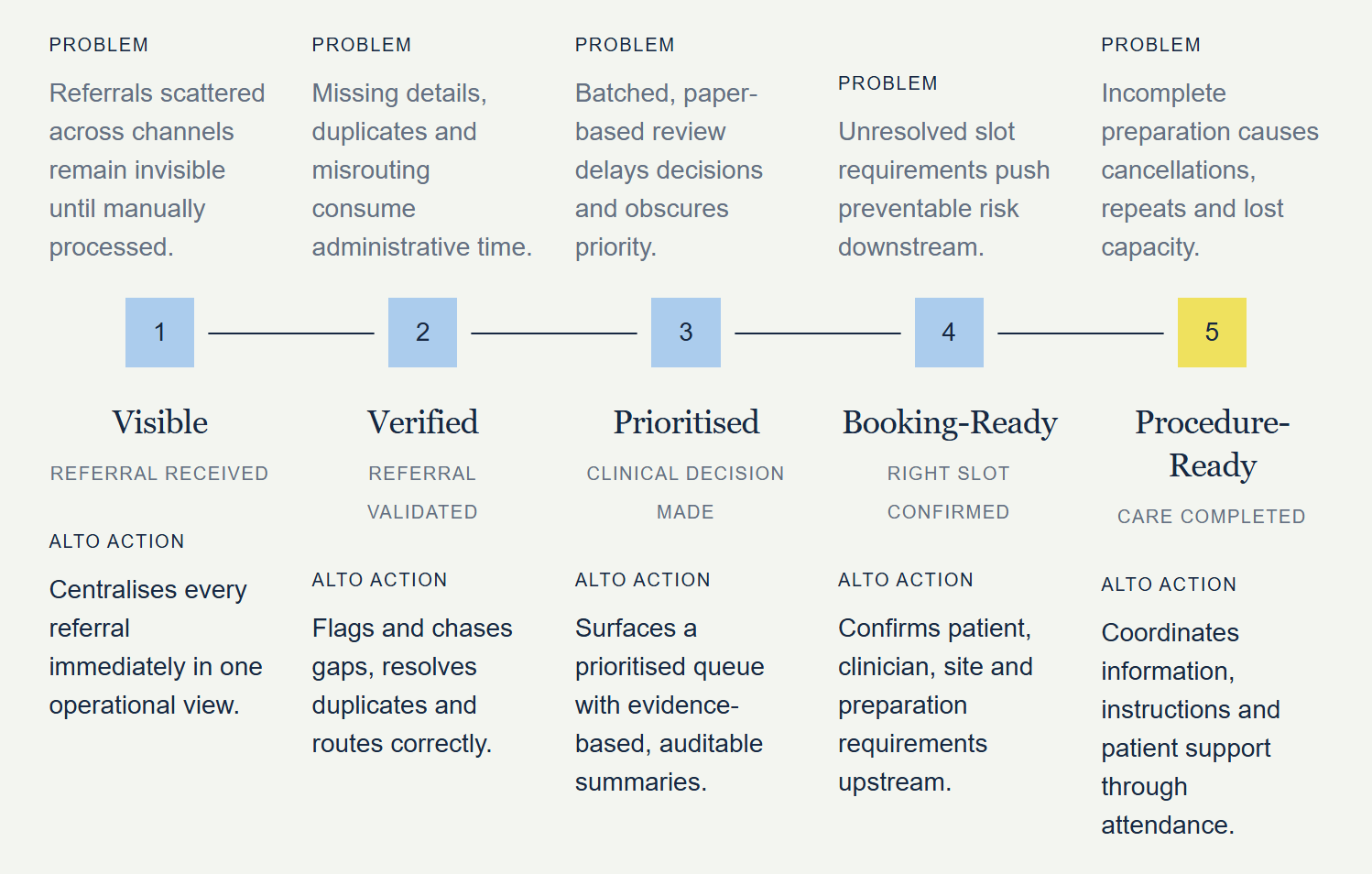
Alto creates the missing operating layer between referral receipt and completed care: every referral becomes visible, verified, clinically prioritised, booking-ready, and procedure-ready.
The Five Stages
-
Referrals arrive across multiple channels, like HealthLink, email, post, fax, and letters, and in multiple formats, for example structured forms, free-text letters, and scanned PDFs. Until someone manually identifies, opens, downloads, understands,and actions each one, it sits outside live reporting or queuing regardless of its urgency.
Alto centralises every incoming referral from every source into a single operational view the moment it arrives, making demand and risk visible so you can plan resources and utilisation.
-
Each referral needs to be timestamped, matched to the right patient, checked for duplicates, acknowledged, routed to the correct specialty or consultant, and reviewed for completeness before it can move to clinical review. This is where the administrative time accumulates: teams spend days chasing missing details, rerouting, returning, and merging duplicates.
Alto automates the entire stage. Missing information is flagged the moment a referral arrives and chased automatically. Duplicates are identified and resolved. Every referral is routed correctly without manual intervention. What took the better part of an hour now takes under five minutes.
-
Each referral is then reviewed by a clinician for appropriateness, priority, and next steps for scheduling or procedure preparation.
Today this often waits for batched review and is frequently PDF- or paper-based, with decisions scrawled on the front. They are then returned by hand to the medical secretary to forward, accept, or chase missing data before digitising into the EHR or PMS. When any of those decisions are delayed or unclear, downstream booking becomes guesswork and care is delayed.
Alto surfaces each referral with a decision ready summary based on local protocols, in a prioritised queue for clinical review. Every summary shows clear, transparent reasoning and evidence drawn directly from the referral document. No black-box results, just an auditable trail the clinician can act on or override.
Clinicians assess the most critical patients in less time, with less clinical admin burden.
When this decision is delayed or communicated unclearly, downstream booking becomes guesswork and care is delayed.
-
Before a slot is offered, the booker and service need to know the slot type, clinician, site, equipment, sedation or anaesthetic need, preparation pathway, pre-assessment requirement, insurance or payment status, patient availability, and minimum lead time. If these conditions are not resolved before booking, risk moves downstream: missing authorisation, medication issues, unavailable escorts, poor preparation and patient constraints surface too late to protect the slot.
Alto resolves these blockers upstream, ensuring the right patient can be placed into the right slot with all requirements confirmed in advance, and patient preparation started.
-
The patient attends with the right preparation completed, the right forms and checks done, the right medication instructions followed, and the right support in place. When this stage fails, the visible symptoms are late cancellations, did-not-attends, inadequate preparation, avoidable repeat procedures, and lost theatre time. In endoscopy alone, inadequate bowel preparation affects around one quarter of colonoscopies. Empty slots are not just administrative failures. They are failed conversions of scarce clinical capacity.
Alto proactively coordinates patient preparation: requesting missing information, issuing preparation instructions, keeping referrers updated on patient status, and supporting patients to arrive ready for care.
The Assistant & Judge Architecture
Alto ingests referral from source, then reads every referral document, in any format, and turns it into a structured, prioritised action. Two independent layers work in sequence so nothing is missed and no decision goes unchecked.
The Assistant
The Assistant ingests and reads the referral, extracts all data, checks it against your organisation's own administrative and clinical rules, and proposes the next action: request more information, flag urgency, move to the clinical queue, or ready for booking.
The Judge
The Judge is an independent QA layer that audits every output the Assistant produces. It catches errors, identifies low-confidence outputs, and flags complex or ambiguous cases for human review.
If the Judge meets a conflict, error or any uncertainty, it does not guess. It routes the file to a person and generates a transparent evidence trail for every decision made so the team and the responsible clinician keep full visibility and accountability at every step. Independently validated and stress-tested.
See the full evidence, validation chain, and safety posture on Why Trust Alto.
The Assistant & Judge Architecture

Alto ingests referral from source, then reads every referral document, in any format, and turns it into a structured, prioritised action. Two independent layers work in sequence so nothing is missed and no decision goes unchecked.
The Assistant
The Assistant ingests and reads the referral, extracts all data, checks it against your organisation's own administrative and clinical rules, and proposes the next action: request more information, flag urgency, move to the clinical queue, or ready for booking.
The Judge
The Judge is an independent QA layer that audits every output the Assistant produces. It catches errors, identifies low-confidence outputs, and flags complex or ambiguous cases for human review.
If the Judge meets a conflict, error or any uncertainty, it does not guess. It routes the file to a person and generates a transparent evidence trail for every decision made so the team and the responsible clinician keep full visibility and accountability at every step. Independently validated and stress-tested.
See the full evidence, validation chain, and safety posture on Why Trust Alto.
Built on Evidence
Alto was not validated as an afterthought. It was built through clinical input, external research and testing at every stage.
Clinical expertise shaped the Assistant from the start. A study with the University of Galway then measured Alto's output against expert clinical judgement across 6,084 data points, finding 92.4% accuracy under the strictest single-reviewer standard. A follow-up analysis with Munster Technological University showed this rising to 98.6% under gold-standard clinician consensus.
That body of work is also what shaped the Judge, Alto's built-in QA layer, because those percentages are real people and real patients, and the cases the reviewers saw differently are exactly the ones a second layer should catch. Work with Ulster University has further strengthened the Judge's design.
Patient safety is also built into how we deploy. Nothing goes live unproven: every deployment moves through the same staged validation, synthetic data first, then the hospital's own historic referrals, then shadow mode alongside the existing process, and only then live.
Alto was also selected as a winner of the Health Innovation Hub Ireland (HIHI) AI Innovation Call 2025/26, and is currently in clinical pilot with a private hospital partner and HIHI at University College Cork.
See the full evidence chain and validation methodology on our Trust page.
Engineered for Interoperability
Alto is designed to enhance, not replace, your existing technology stack. Rather than requiring a rip-and-replace of current systems, Alto sits as an intelligent layer between your incoming referrals and your EHR or PMS, passing clean, structured data through in real time.
Alto is built on FHIR-based interoperability standards and integrates with leading EHR and PAS systems used across Ireland and the UK, including Meditech, System C, and Dedalus.
As a CE Class I Medical Device, Alto meets the clinical safety and data security requirements of the most demanding healthcare governance boards. All integrations are fully compliant with UK and EU GDPR and Cyber Essentials Plus.
See our full security and compliance posture on our Safety and Governance page.
Modular by Design
The five stages above are the full journey Alto orchestrates. You don't have to switch it all on at once. You can start with administrative capability and move into clinical and semi-automated work only as each layer proves itself. Every module clears the same staged validation before the next is turned on.
-
Document management and referral efficiency. Pulls referrals in from any channel and turns unstructured letters into a clean, structured record, with no manual re-keying. Admin and clinical teams work from one live surface: backlog, workload allocation, state tracking, and a full audit trail, with a real-time view of volumes, processing times, and waiting-list status.
Missing data detection and collection. Checks each referral is complete, flags what is missing, and helps gather it before it holds up a booking. Fewer rejected or wasted slots.
Patient and referrer communications. Two-way, multi-channel contact to confirm receipt, collect information, and keep referrers updated.
Referral source analysis. Breaks down where referrals come from and how each source and referrer performs, so outreach can target the channels and practices worth investing in.
-
Red flag detection and priority tracking. Surfaces red flag signals early and tracks priority as a referral moves, so time-critical cases are not left buried in an inbox.
Clinical vetting. Standardises clinical vetting and prioritisation across consultants, so decisions are consistent and auditable.
Pre-visit readiness. Guides patients through preparation and confirms everything is ready before the visit, reducing cancellations and aborted procedures.
-
Progressive semi-automation. As accuracy is proven field by field, Alto handles the highest-confidence, lowest-risk work automatically and routes everything else to a person.
Explicit confidence thresholds decide what is auto-accepted, what goes to human review, and what is escalated, so oversight relaxes only where the evidence earns it.
Evidence first, validation at every stage, and capability that builds only once it has earned the right to.