
Alto manages the journey from incoming referral to completed care. Independently validated. CE-marked Class I medical device. In active pilot deployment.
From incoming referral to completed care
Every referral checked twice. Every decision human.
PLATFORM

THE PROBLEM
The gap between referral and procedure is where capacity is lost
The path from referral to care is not a workflow; it is a chain of manual handoffs, each a failure point. Incomplete inputs, fragmented handoffs, and readiness issues discovered too late to protect the slot.
20- 40 mins
admin per referral
1 in 3
referrals incomplete
x in x
cancelled late
10–15%
of referrals lost
Alto is the missing operating layer: every referral visible, verified, clinically prioritised, booking-ready, procedure-ready.
HOW IT WORKS
Alto closes the gap between referral and procedure
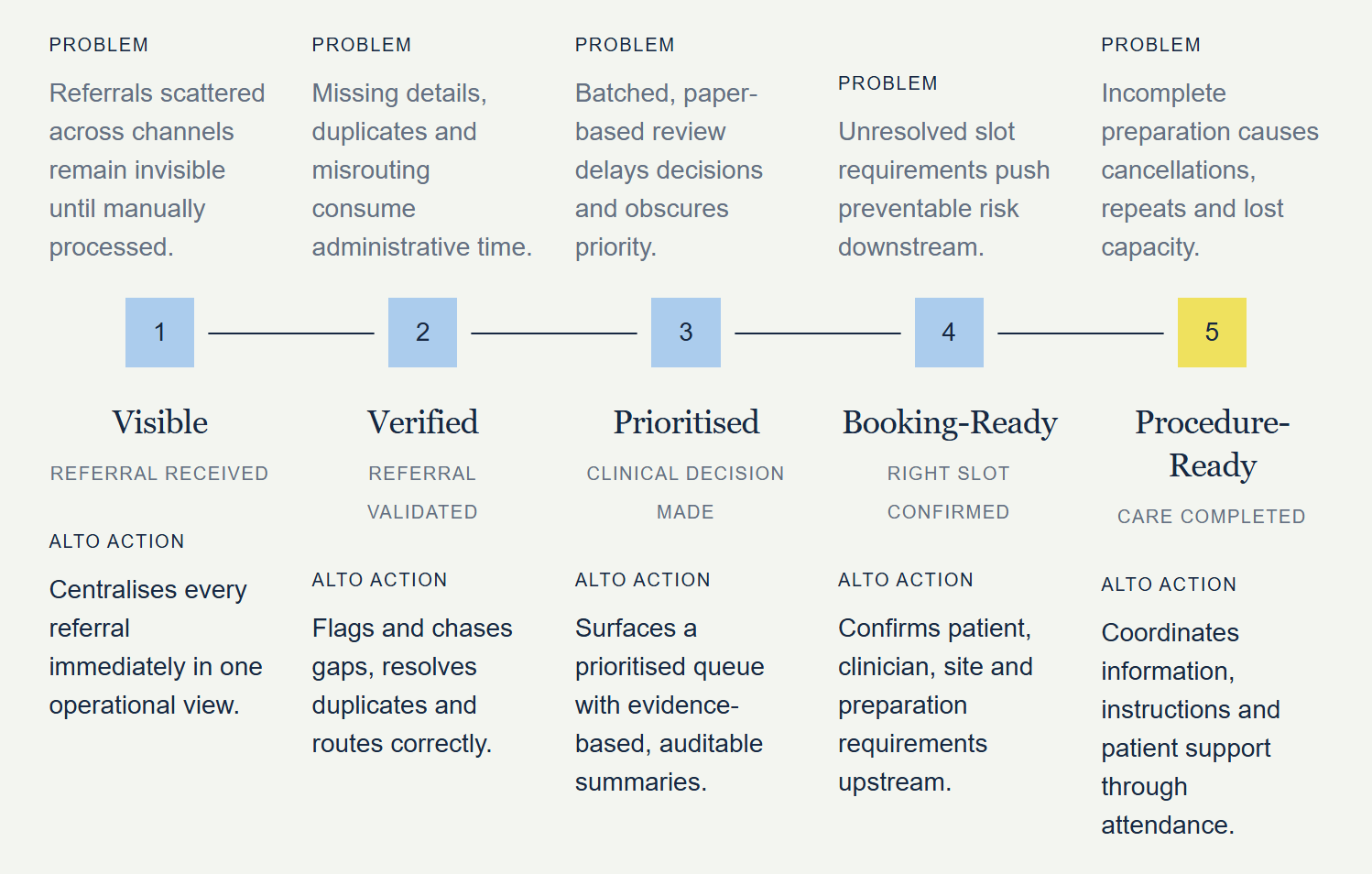
Five stages, from the moment a referral arrives to a patient who turns up prepared.
-
Every referral on the radar from the moment it arrives
Referrals land by HealthLink, email, post and fax, as forms, letters and scanned PDFs, and sit outside live reporting until someone opens them, whatever their urgency. Alto centralises every referral into one operational view on arrival, so demand and risk are visible. -
The administrative hour, done in minutes
Timestamping, patient matching, duplicate checks, acknowledgement, routing, completeness: this is where the administrative days go. Alto automates the stage. Missing information is flagged on arrival and chased automatically, duplicates resolved, routing handled. In minutes instead of most of an hour. -
Urgent cases surface first, with the evidence shown
Clinical review often waits for batched, paper-based decisions, and delay turns booking into guesswork. Alto surfaces each referral with a decision-ready summary based on local protocols, in a prioritised queue, with transparent reasoning and evidence from the referral itself. No black box: the clinician acts or overrides. -
The right patient in the right slot, blockers cleared upstream
A slot needs the right type, clinician, site, equipment, sedation, preparation pathway, pre-assessment, insurance and lead time; unresolved, these surface too late to protect it. Alto clears the blockers upstream: the right patient in the right slot, preparation started. -
Patients arrive prepared, lists run full
When preparation fails: late cancellations, non-attendance, repeat procedures, lost theatre time. In endoscopy alone, inadequate bowel preparation affects around one quarter of colonoscopies. Alto coordinates preparation proactively: chasing information, issuing instructions, updating referrers, supporting patients to arrive ready.
HOW IT'S SAFE
The Assistant & Judge Architecture

The Assistant
The Assistant reads every referral in any format, extracts the data, checks it against your administrative and clinical rules, and proposes the next action.
The Judge
The Judge independently audits every output: catching errors, identifying low-confidence results, flagging ambiguous cases for human review. Faced with uncertainty it does not guess; it routes the file to a person, with a transparent evidence trail behind every decision, so the responsible clinician keeps full visibility and accountability.
See the full evidence, validation chain, and safety posture on Why Trust Alto.

Built on evidence
Clinical expertise shaped the Assistant from the start. A University of Galway study measured Alto against expert clinical judgement across 6,084 data points: 92.4% accuracy under the strictest single-reviewer standard, rising to 98.6% under gold-standard clinician consensus in follow-up analysis with Munster Technological University. That work shaped the Judge (the cases reviewers saw differently are exactly what a second layer should catch), strengthened further with Ulster University.
Nothing goes live unproven: synthetic data, then the hospital’s own historic referrals, then shadow mode, then live. Alto won the Health Innovation Hub Ireland (HIHI) AI Innovation Call 2025/26 and is in clinical pilot with a private hospital partner and HIHI at University College Cork.
Engineered for interoperability
Alto sits between your incoming referrals and your EHR or PMS, passing clean, structured data through in real time. Built on FHIR; integrates with Meditech, System C and Dedalus. A CE-marked Class I medical device, compliant with UK and EU GDPR and Cyber Essentials Plus. [See Safety and Governance.]


Modular by design
Start with the foundations; expand as each layer earns its place, each module clearing the same staged validation.
Foundation: Administrative
Document management: referrals from any channel turned into clean records, no re-keying; one live surface for backlog, workload and audit trail.
Missing data detection: gaps flagged and gathered before they hold up a booking.
Patient and referrer communications: two-way, multi-channel confirmation, collection and updates.
Booking and scheduling: cleared referrals moved into the right slot, with the blockers resolved first.
Referral source analysis: which channels and referrers perform, so outreach targets what converts.
Capacity and demand: live pipeline visibility, so staffing and list planning follow demand rather than guess it.
Foundation: Clinical
Red flag detection and priority tracking, so time-critical cases are never buried.
Clinical vetting standardised across consultants: consistent, auditable decisions.
Pre-visit readiness: patients guided through preparation, reducing cancellations and aborted procedures.
Foundation: Semi-automation
As accuracy is proven field by field, Alto handles the highest-confidence, lowest-risk work automatically and routes everything else to a person.
Explicit confidence thresholds decide what is auto-accepted, reviewed or escalated, so oversight relaxes only where the evidence earns it.